Seven percent for the people
 René Hoyer
3 min read
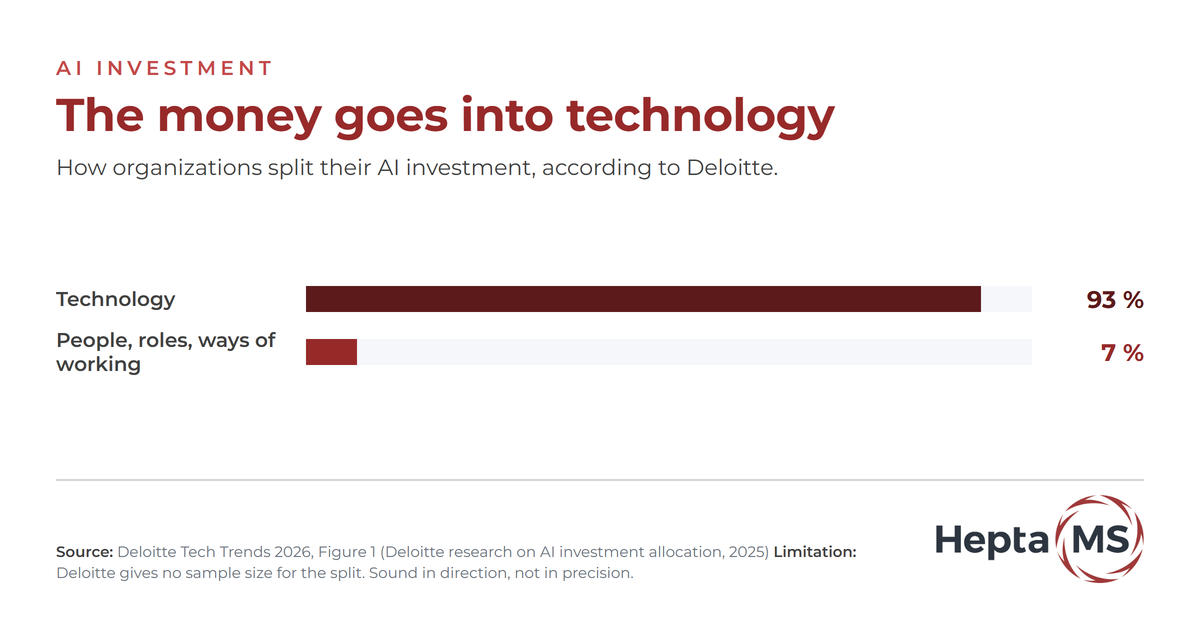
Of every dollar organizations put into artificial intelligence, seven cents reach the people who are supposed to work with it. The rest goes into licences, platforms, compute and integration. That is what Deloitte Tech Trends 2026 reports, and it matches what I see in IT organizations: the budget follows the tool.
What the split costs
On its own this would be a budget footnote. It becomes interesting next to a second Deloitte figure. In the 2026 Global Human Capital Trends, Deloitte cites a survey of 100 C-suite leaders: 59 percent of organizations take a tech-focused approach to AI. Those organizations are 1.6 times as likely to miss returns that exceed their expectations as organizations that start with people.
A hundred respondents is not a large sample, and the 93 to 7 split comes without any note on method. The direction of both figures is still unambiguous, and they point the same way: the money flows to where returns appear least often.
Why technology alone is not enough
The reason lies in the workflow, not the tool. AI lowers the cost of doing. A draft, an analysis, a piece of code takes minutes. It does not lower the cost of deciding. Someone still has to check whether the draft is right, approve whether it may go out, and agree who is responsible for what.
When doing gets cheaper, the volume that needs checking and approval grows. Review capacity does not. So the bottleneck does not disappear, it moves: out of production and into approval, review and alignment. That is the core of Lean-AI, and it is the field Lean has worked on for seventy years.
An organization that puts 93 percent of its AI budget into technology speeds up the step that is already getting fast. The step where work piles up gets seven percent.
Where the money belongs
Investing in people does not mean training days for the new tool. It means the things that clear the bottleneck:
- Clear decision rights. Who approves what, from what level of impact, and what may run without approval.
- Limits instead of more review. What an agent may touch, how to get back, how to tell that something has gone wrong. Within such limits, not every result has to be looked at one by one.
- Roles for the flow of work. Someone owns what creates value, someone owns the cadence, someone owns technical soundness. In HeptaMS these roles are Value Owner, Flow Owner and Architecture Owner.
- Learning in the flow of work. Deloitte names this as one of the traits of the organizations that are ahead: learning happens inside the work, not beside it.
None of this appears on a licence invoice. That is why it drops out of the budget, and that is why the return stays away.
The question for the next budget
The 93 to 7 split is not a law of nature. It happens because technology is easier to get approved than a new way of making decisions. Anyone planning the next AI budget can run a simple check: which part of it changes how the organization decides, approves and aligns? If the answer is in single digits, the outcome is predictable.
How leadership stays in control under these conditions is described on Lean-AI for leaders. The Lean-AI Leader course works through exactly these questions against the participants' own organization.
Sources: Deloitte, Tech Trends 2026, Figure 1. Deloitte, 2026 Global Human Capital Trends, p. 3, citing Cantrell et al., "Scaling your human edge", 2025 (100 C-suite leaders).
Frequently asked questions
Where does the 93 to 7 split come from?
From Figure 1 of Deloitte Tech Trends 2026, attributed there to Deloitte research on AI investment allocation in 2025. The report gives no sample size.
How reliable is the factor of 1.6?
It comes from a Deloitte survey of 100 C-suite leaders, cited in the 2026 Global Human Capital Trends. The direction is clear, the sample is small.